Falling Forever
Hourglasses & Ever Presence

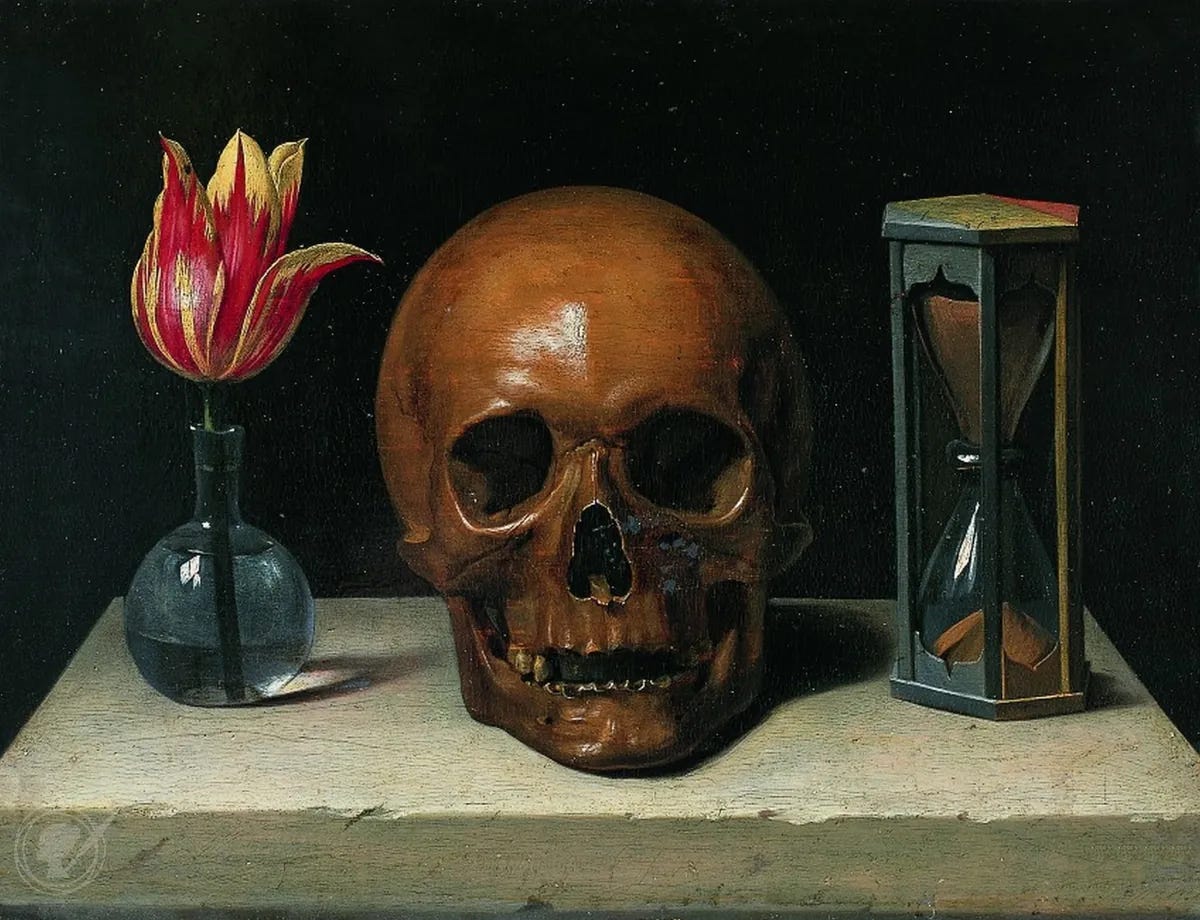
Vanitas Still Life by Phillippe de Champaigne
We speak of losing time. Passing time. No time. And yet nothing happens outside of time, a substance we constantly assert is scarce, limited, and hard to hold onto. But a single moment while it may pass through the neck of the hourglass is never lost. The sand still dwells within that glass although it has been translated from one bulb to the other. The reframe for me is that time is not the sand or its passage. It is the glass instrument itself, holding all moments, all hours past, present, and yet to come.
For those with a legacy of violence and abuse this is not a thought experiment. Flashbacks queer our idea of time’s arrow. They flood us with such sensory detail, such complete rendering, that it can be near impossible to distinguish them from our current reality. Those with PTSD know that while the sand passes through the neck of the hourglass, that glass can easily be turned over, returning us to the worst moments of our lives. A flashback isn’t an illusion. The way it registers in our nervous systems can be analogous to the actual physical state of imminent threat. The heart speeds up. Blood leaves our extremities, pulled towards protecting our core. It has been suggested that a PTSD flashback is categorized in our brain as an actual interruption in our current timeline rather than a memory being consciously accessed.
In the past month as the Epstein Files have dominated public conversation, I have found it impossible to avoid the triggers that I know can bring on my worst flashbacks. Often at three in the morning I wake with a terror clamped at the base of my spine so primitive it feels like I am about to shatter. A smell or the image of a television screen is enough to remind me that certain moments never pass away.
Six years ago, inoculated with The Body Keeps the Score and simplistic, punishing wellness paradigms, I was actively trying to cure these flashbacks. The short story is that none of the treatments “worked” and quite a few left me sadder, sicker, and poorer. For the long-yarn version of that story, you can read my memoir The Body Is a Doorway. But lately I’ve decided I don’t need to cure my body’s refusal to accept time’s arrow.
I am not a timeline. I am an hourglass that can be flipped upside down. I am a container for moments that flow and remix and move and care little for linearity. My time cannot be spent or squandered or lost. And it does not diminish on the horizon as I travel towards some ultimate destination.
Instead, I need to look at my body’s refusal to accept causal time with a much wider lens. Yes, there are bitter, terrible grains in my hourglass. And occasionally they pass through the connecting stem of the 1/18th of a second human instant we consider the present moment. But there are many other grains of sand that hold great beauty and great love.
These past two years I have looked my mortality solidly in the face as I have navigated potentially terminal diagnoses and increasingly complex physical issues. And I have had to get very sober about the reality that all my prayers may not answered in a single life and that the only power I have is in accepting with complete and utter gratitude all that is currently present rather than viewing my life as somehow deficient in comparison to an imaginary future that may never arrive.
I would like to live a long life. I desire romantic love that lasts. A marriage plot. The potential to have children. I am also very sober that those are not givens. And I know that I don’t want to go to my death whenever it happens feeling as if I was denied beauty and love. When you are a single woman in your thirties you often feel haunted by a timeline of failed relationships and your diminishing fertility. Pair this with degenerative chronic illness and it can really feel like the sand leaks out of the hourglass, never to return.
I saw a meme the other day and laughed sending it to another single friend that said something along the lines of, “A crush is a just a lack of information”. In many ways this is true. Once someone betrays us or betrays our idea of who they were supposed to be to us, it is very easy to discount the honeymoon phase of falling in love. We were never in love. We were deluded! For women this sobering up is an incredibly important part of exiting abusive relationships without romanticizing an imaginary version of an ultimately harmful partner.
I’ve lived this.
But I also don’t think any of the love I’ve ever felt was wrong. And I also don’t think any of it has stopped happening.
As spring arrives like a revelation in the Hudson Valley after a long, bitter winter, I am reminded of falling in love. It always feels like the first time. And then if it ends in heartbreak, we discount it as having been fantasy.
But we don’t discount the spring like we do our emotional seasons. The spring is never finished and it is never passed. It is always around the corner. It is always coming again and having been. And somehow it is always soul-hushing in its beauty and freshness.
Yes, the horrors keep happening. But so does the springtime.
I have been cultivating an equal and opposite temporality as informed by and in opposition to a simplistic conception of PTSD.
If I smell the lemon unfurling of magnolia blossoms, if I hear the first bell-like shiver of the stream shimmying through snowmelt, if I see the sunset like a smear of raspberry jam above the blue line of the mountains, then I am once again falling in love.
If I must always return to my worst moments, may I also always return to those personal springtimes.
I sit here replete with blessings that are not discounted by their inevitable diminishment. Time’s glass embrace keeps the grains moving not along any line, but up and down, back and forth. If I am haunted by horror, then I flip the hourglass.
Suddenly, once again the ground softens with early wood violet. Spring is always happening. And I am always suspended as a grain of sand inside the crystalline moments of a love that doesn’t ever stop falling.
This has been the free version of my newsletter. If you choose to support the paid version of this newsletter, you will receive at least two newsletters a month featuring everything from new essays, reflection on writing craft, poetry, excerpts from my upcoming books and projects, mythic research, reading lists, poetry, book reviews to ecological embodiment exercises, playlists, personal updates, and generally a whole lot of funk and texture.
I am overwhelmed with gratitude by how many of you have showed up here to support my work and widen my thinking. Right now you are literally keeping me alive and funding the out-of-pocket medical expenses and connective tissue specialists.
I am grateful in a way that is wide and deep and low. I hope you can feel some sonorous note of it - the hum and grind of ice relaxing under the sun - in your body. I am sending the song of my thanks your way. I love you all so much
Thank you for your beautiful honesty. It helps us all. Blessings, A
Thank you for your beautiful and true words. Is is always both at the same time, never but, always and. ❤️