Star-Breaking
Autotomy & Survival

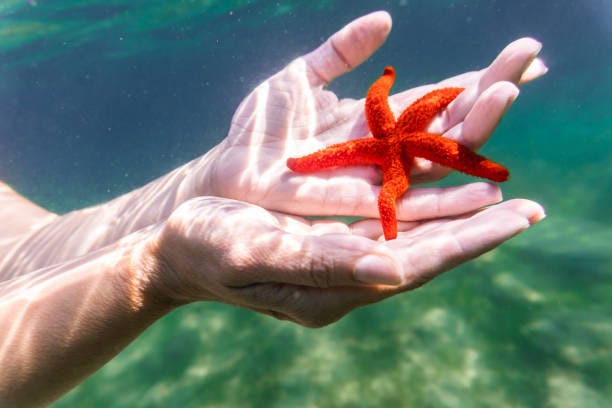
The star is bright as emergency, tangerine stark against a wash of blue that is not the heavens but those sublunar tides that coil below the ocean’s surface. This is not a gaseous giant hung in some distant galaxy. No, it is a fleshy and vulnerable cosmos that slowly suctions its way across the sea floor, embarrassingly removing its own stomach to feed, wrapping its physical appetite around its food in an act closer to hugging than it is to our human conception of eating.
A shadow curves overhead reminiscent of a hawk circling its prey, but the shape that descends is a flipper instead of a wing.
The star quivers, shimmers, emits a saponin-rich substance designed to deter its enemies, but the sea turtle is unperturbed…and hungry. He makes an initial bite that the star managed to evade while knowing that long-term survival depends on more than just speed.
Does the starfish consciously decide to break? Or does it’s body begin the process of fragmentation the second that stress hormones crescendo? Suddenly the star is no longer singular. Two of its legs have literally walked away from its body, shaking and quivering in an exaggerated fashion to distract the hungry predator. The sea turtle pivots, swimming towards one of these detached yet sentient legs, giving the star time to slip between seed reeds into the safety of the sea beyond.
This process of self-amputation is referred to as autotomy in biology, a phrased coined by Leon Fredericq in 1883 from the Greek auto “self” and tome “severing. The process of severing or shedding an appendage as a method self-defense is not unique to the starfish. It is believed to have evolved independently at least nine times.
I am reminded of the story of mountaineer Aaron Ralston, made even more popular by the James Franco vehicle 127 Hours, whereby Ralston survived being pinned by a dislodged boulder in Bluejohn Canyon for five days by finally breaking his forearm and using a dull pocket-knife to amputate his arm. After this extraordinary act of autotomy, Ralston continued to hike the rest of the canyon, managing to repel down a 65-foot drop and cover seven miles before he was finally rescued.
I’ve always loved survival stories and as I’ve grown older, I’ve suspected it is because I’m taking notes. I’ve experienced my fair share of life-threatening violence and danger. I’ve also experienced the painful and damaging if less physically urgent pressures of emotional abuse and control.
I’ve never cut off my arm. But I’ve certainly used Ralston and the starfish as a metaphor in the past to describe the tension between death and survival. It is not often a choice between pain and no-pain. It is often a choice between personal extinction and extreme pain that ultimately ensures your survival.
Sometimes to live, you need to consciously decide to break.
Release an arm. Distract the predator. Fragment.
The heart that doesn’t break, dies. The body that doesn’t self-amputate, will succumb to the infection in the rotten limb. The star that stays singular ensures its extinction.
Fragment. Become plural. Crack. Disable yourself to save yourself. These are the tactics of those who are not at the top of the food chain, who were not given the predator’s tools in the dominant culture.